
Cyber Strike Manager Idle
Payge LimitedSimulation
3.4270.00 Reviews
- Version
- 1.3.4
- Installs
- 100.00K
- Age Rating
- Everyone
Screenshots
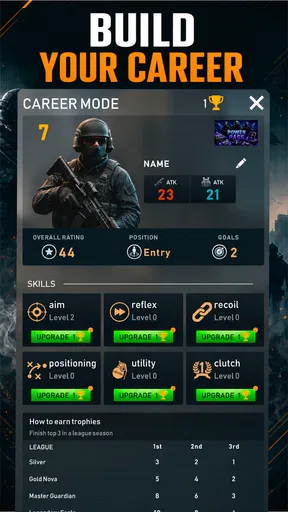
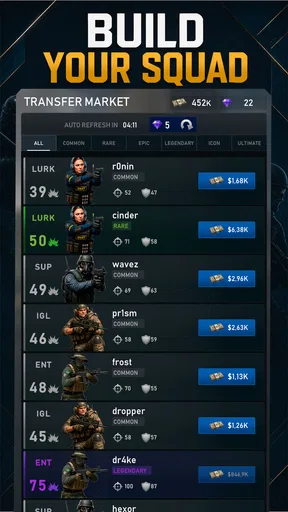
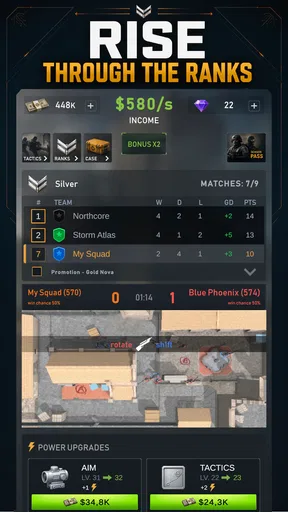
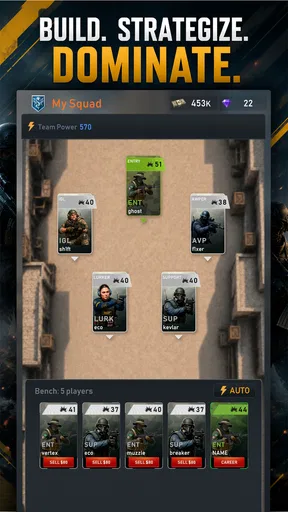
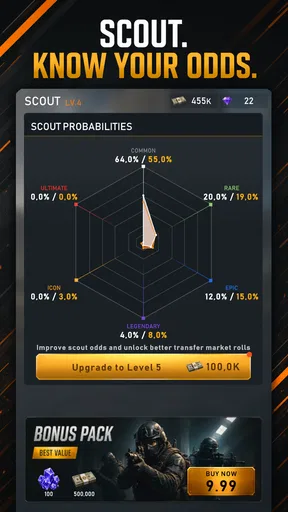
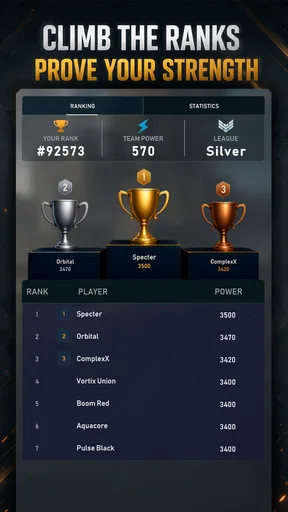
Our Review of Cyber Strike Manager Idle
 Analysis by Appyee
Cyber Strike Manager Idle is the kind of mobile simulation game I open when I want to make a few meaningful decisions without committing to a long, hands-on session. Its central idea is straightforward: assemble a tactical five-player team, sign players, enter matches, and work upward through leagues. What makes it more interesting than a simple sports-style menu simulator is the constant question behind every choice: am I improving the team I have now, or preparing for a stronger team later?
After spending time with it, my view is fairly clear. Cyber Strike Manager Idle works best as a lightweight team-building game with a competitive theme, not as a deep replacement for a full management simulator. It gives me a pleasant loop of checking progress, adjusting a roster, and deciding where limited resources should go. At the same time, players looking for detailed match control, a rich tactical sandbox, or a highly transparent competitive system may find its idle structure too restrained.
The game is free to start and is suitable for Everyone, which makes it easy to try casually. Payge Limited presents it as a simulation title, and that description fits: the main pleasure comes from managing a squad and watching the consequences of those decisions rather than directly controlling every moment of a match. The current version is 1.3.4, and the game requires Android 7.1 or later. It has passed the early discovery stage too, with over a hundred thousand installs, although its average rating sits at 3.4 from around five thousand ratings, so expectations should remain measured.
How the management loop feels in everyday play
I find the everyday loop easiest to judge by asking what I want from a short visit: a quick roster check, a deliberate upgrade, or simply a pause from more demanding games. That distinction matters because the same hands-off rhythm can feel relaxing or too passive, depending on how much control I expect. With that in mind, the next section looks at where this manager earns its place beside other options.
A quick routine that suits short sessions
My favorite way to play is in short visits throughout the day. I check the squad, look at the next opponent, review what the team has earned, and then decide whether to strengthen the current lineup or save resources for a more important signing. That routine is much more practical than treating the game like a traditional strategy title that demands constant attention.
A realistic example would be opening the game during a commute or while waiting for an appointment. I can inspect the team, make one or two changes, and leave without feeling that I have abandoned a complicated live battle. Later, I return to see whether the new arrangement helped. This makes the game a good companion for players who enjoy gradual progress but do not want a session to consume an entire evening.
The trade-off is that the same convenience can reduce the feeling of direct involvement. I am usually preparing the conditions for success rather than personally executing every move. If a match goes badly, the answer is often found in roster quality, preparation, or resource allocation instead of a last-second tactical command. That is satisfying when I want a manager’s perspective, but less satisfying when I want to feel responsible for every play.
Building a team is more than choosing the strongest name
The five-player format gives roster decisions a useful sense of pressure. Every signing matters because there are not many places to hide a weak option. I have to think about whether an upgrade solves an immediate problem or simply looks attractive in isolation. A powerful new player is not automatically the right purchase if the rest of the team remains underdeveloped.
One practical habit I recommend is keeping a simple mental priority list before spending. I first identify the position or role that is holding back the team, then compare that need with the cost of improving it. This prevents the common idle-game mistake of spending whenever a tempting option appears. Saving for a targeted improvement can feel slower, but it usually gives the team a clearer direction.
That approach also helps players understand what kind of manager they want to be. Some will enjoy building a balanced lineup, while others will prefer concentrating resources on one standout player and accepting weaknesses elsewhere. Cyber Strike Manager Idle leaves room for both instincts, although the game is more enjoyable when I treat each purchase as part of a plan rather than as an isolated reward.
League progress gives the decisions a reason
Climbing leagues provides the long-term context that keeps the individual matches from feeling disconnected. A win is not just a win; it becomes evidence that the current squad is ready for a tougher stage. A loss, meanwhile, encourages me to reconsider whether I rushed upward or neglected a key part of the roster.
I like this structure because it creates natural stopping points. I can play until the next upgrade, the next match, or the next league goal, then put the game down. It is easier to maintain than a game with a huge map or a long campaign that expects a continuous commitment.
Still, league progression can feel repetitive if the player does not enjoy incremental improvement for its own sake. The game’s appeal depends heavily on whether watching numbers and team strength develop feels rewarding to you. Players who need a constant stream of dramatic story moments may find the climb too methodical.
Where the idle design helps and where it gets in the way
The idle element is useful because it lets progress continue between visits. I do not need to be staring at the screen to feel that the team is moving forward. That makes the game less demanding than a conventional competitive title and reduces the pressure to react instantly.
However, idle progress also changes how I judge success. I am not measuring myself only by tactical skill; I am measuring whether I made sensible decisions before leaving the game. The best results often come from preparing the roster, claiming what is available, and returning at the right time to reinvest. This is a quieter form of strategy, and it rewards patience more than reflexes.
My most useful tip is to avoid treating every available reward as permission to spend immediately. In a game built around gradual growth, a reserve can be more valuable than a small improvement that feels exciting in the moment. I also find it helpful to make changes one at a time when possible. If I alter several parts of the team together, it becomes harder to understand which decision actually improved the results.
Spending and the free-to-play question
The game is free, but optional purchases range from $0.99 to $99.99 per item. That wide range matters because the experience can appeal to both cautious players and people comfortable investing more heavily in progression. I would begin without spending and first decide whether the basic management loop holds my attention. The early question is not whether a purchase might accelerate progress; it is whether I enjoy the decisions enough to want that acceleration.
For me, the strongest way to approach the purchase system is as a convenience choice rather than a requirement. If I am enjoying the team-building process, a small optional purchase may feel reasonable. If I am already bored by the repetition, spending more will not solve the underlying problem. Players who dislike any form of in-app purchase pressure should be especially careful with a game whose individual items can reach a high price.
Another useful rule is to separate competitive impatience from genuine enjoyment. Losing a match can make an upgrade feel urgent, but that does not necessarily mean the team needs immediate spending. I prefer to wait, observe the next few results, and decide whether the weakness is consistent. That pause makes the game feel more like management and less like reacting to every setback.
What the rating and audience signals suggest
The game’s 3.4 average from around five thousand ratings tells me that it is likely to divide players rather than satisfy everyone equally. That makes sense for an idle manager: some people enjoy the slow accumulation and roster decisions, while others may see the same structure as limited or repetitive. I would not use the rating alone to dismiss it, but I would treat it as a reminder to match the game with the right expectations.
Its Everyone age rating also makes it approachable for a broad audience. That does not automatically make it ideal for every younger player, since the resource and purchase decisions still require judgment, but the presentation is accessible enough for casual family-device use. Adults who want a complicated competitive simulation should look elsewhere, while casual players may find the lower commitment appealing.
Where it stands beside other simulation games
Compared with a traditional sports management game, Cyber Strike Manager Idle is lighter and more immediate. I spend less time studying detailed systems and more time making compact decisions about the squad’s next step. That makes it easier to learn, but it also means there is less room for players who want extensive statistics, elaborate contracts, or minute-by-minute tactical control.
Compared with a direct-action competitive game, it is much calmer. I am not relying on fast reactions or precise controls during a live encounter. The appeal is in preparation and progression, so it suits someone who enjoys the idea of competition without wanting the stress of constant execution.
It also differs from a purely passive idle game because the team-building choices give me a reason to pay attention. I am not simply collecting rewards and tapping through an automatic sequence. The roster and league structure create decisions, even if those decisions are presented in a simplified way. That middle ground is the game’s clearest identity.
The limitations I noticed during longer sessions
The main weakness is depth. The five-player team sounds tactically focused, but a compact roster can also make the decision space feel narrow once I understand the basic priorities. If the most reliable path is always to strengthen the weakest area and keep climbing, experimentation may become less rewarding over time.
The idle format creates a second limitation: the matches do not always feel like events I am actively playing. I can prepare carefully, but I may still want more feedback explaining why a result happened. When the game gives me a disappointing outcome without enough tactical context, it is harder to learn from the loss. That can make progression feel like a resource check instead of a strategic lesson.
There is also a potential tension between convenience and engagement. Short sessions are easy to fit into daily life, but the game may not provide enough variety for a long uninterrupted sitting. I would recommend treating it as a game to revisit, not one to marathon. That expectation improves the experience considerably.
Players should skip it if they want direct control over every match, a highly detailed simulation, or a purely offline-feeling experience without purchase considerations. A deeper management game will be a better choice for someone who enjoys complex planning, while a real-time action title will suit anyone who wants their personal skill to decide the outcome moment by moment.
Who will get the most from it
I think the best audience is made up of casual strategy fans who enjoy gradual improvement and do not mind letting a game breathe between sessions. It is particularly suitable for someone who likes checking a roster, making one meaningful adjustment, and returning later to evaluate the result. The league climb gives those small decisions a visible destination.
It is also a reasonable option for players who are curious about team management but find full simulations intimidating. The five-player structure is easier to understand than a huge organization with dozens of moving parts. Newcomers can focus on the basics of recruitment, balance, and timing before deciding whether they want something more demanding.
I would be more cautious recommending it to dedicated competitive players. If your enjoyment comes from mastering precise mechanics or discovering a large number of viable tactical systems, this game may feel too simplified. Likewise, anyone who tends to spend impulsively when progress slows should set a personal budget before starting, especially because individual purchases can range from less than a dollar to nearly a hundred dollars.
My final recommendation
Cyber Strike Manager Idle is a pleasant, focused team-management game when approached as a slow-burn daily habit. Its strongest qualities are the approachable five-player structure, the clear league goal, and the ability to make progress in short sessions. I enjoy the way it turns roster choices into a series of manageable decisions, especially when I resist the urge to spend resources without a plan.
Its weaknesses are just as important. The tactical depth is limited compared with fuller management simulations, match outcomes may not always teach me enough about what went wrong, and the idle structure can become repetitive during long sessions. The purchase range also means careful players should decide in advance whether they want to remain entirely free or spend only within a strict limit.
Payge Limited has created a game that is easy to sample and simple to revisit. With a free entry point, an Everyone rating, and support for Android 7.1 or later, it is accessible to a broad group of casual players. I would recommend it to anyone who wants a compact simulation game about building a cyber-themed team and climbing steadily. I would not recommend it to someone seeking a deep managerial laboratory or a skill-driven competitive experience.
In the end, I see it as a good fit for the gaps between bigger games: a quick check in the morning, a roster decision during a break, and a return later to see whether the team has earned its next step. That is not a spectacular formula, but it is a coherent one. If that rhythm sounds appealing, the free download makes trying it sensible; if you need constant control and deep tactical explanation, your time is probably better spent with a more comprehensive alternative.
Verdict
Strengths of Cyber Strike Manager Idle
- Simple idle mechanics make progress easy to manage in short sessions.
- Team upgrades provide a satisfying sense of long-term progression.
- Cyberpunk visuals give the game a distinctive futuristic atmosphere.
- Offline earnings let your squad continue generating resources while away.
- Multiple fighters encourage experimenting with different team combinations.
Limitations of Cyber Strike Manager Idle
- Progress can feel slow without frequent upgrades or extended waiting.
- Repeated battles may become monotonous after the initial stages.
- Higher-level upgrades can require substantial amounts of in-game currency.
- The interface may feel crowded for players unfamiliar with idle RPGs.
- Limited strategic control may disappoint players seeking hands-on combat.
Similar Picks in This Category
View All
Truckers of Europe 3
Wanda Software4.3

Town Building Life Simulator
XGame Global4.2

Fidget Toys Trading・Pop It 3D
Freeplay Inc4.7

Sculpt People
CrazyLabs LTD4.4

Scary Teacher 3D
Z & K Games4.2

Hair Tattoo: Barber Shop Game
CASUAL AZUR GAMES4.3
Frequently Asked Questions
What is Cyber Strike Manager Idle?
Cyber Strike Manager Idle is an idle management game in which you build and expand a futuristic cyber-strike operation. You recruit or upgrade units, manage resources, improve your base, and send your forces into missions. Much of the progress continues automatically, making it suitable for players who enjoy strategy and progression without needing to remain constantly active.
How does the idle progression system work?
The game generates rewards while you are playing and, in many cases, while you are away from the app. When you return, you can collect accumulated resources and use them to upgrade your team, facilities, equipment, or other systems. However, active decisions still matter because choosing the right upgrades and missions can make progress faster and help you overcome increasingly difficult enemies.
Is Cyber Strike Manager Idle free to download and play?
Cyber Strike Manager Idle can generally be downloaded without an upfront purchase, but players should expect optional in-app purchases and possible advertising. These extras may provide additional resources, speed up timers, or offer convenience items. You can usually make progress without spending money, although free players may need more patience and should review purchase settings before handing the game to children.
Does the game require an internet connection?
An internet connection may be needed for certain features, including account synchronization, advertisements, special events, updates, and purchases. Some basic gameplay may continue when the device is temporarily offline, but offline availability can vary depending on the version and platform. For the most reliable experience, open the game online periodically so progress and rewards can be properly synchronized.
Is Cyber Strike Manager Idle suitable for casual players?
Yes, the game is designed primarily for casual players who enjoy gradual upgrades and automated rewards. You can check in for a few minutes, collect income, improve your operation, and start new missions without committing to long sessions. Players seeking deep real-time strategy or highly competitive controls may find it simpler, but its relaxed progression makes it accessible to beginners.
Play our best games!


